If you’ve been around the block in modern software development, you’ve heard of LeetCode. To some it is a fascinating playground of logic. To most it feels like a mandatory, exhausting barrier to entry set by the gatekeepers of Big Tech.
The truth is, very few engineers open LeetCode unless they are actively looking for a job. The second we get a role we end the tab and vow to never look at an array inversion problem again.
But after years of coming and going on this platform, hating the grind, respecting its benefits, hating it again, I have realized that to avoid it completely is to miss out on real professional growth. You don’t have to love the algorithmic interviewing complex to get a lot of value out of it.
Let’s cut through the marketing hype and the cynical “grind culture” and find out how LeetCode really works, why it is still the default standard for top employers, and how you can use it to build real engineering skills without losing your mind.
Algorithmic puzzles are king in tech hiring. Why?
What is the main function of LeetCode?
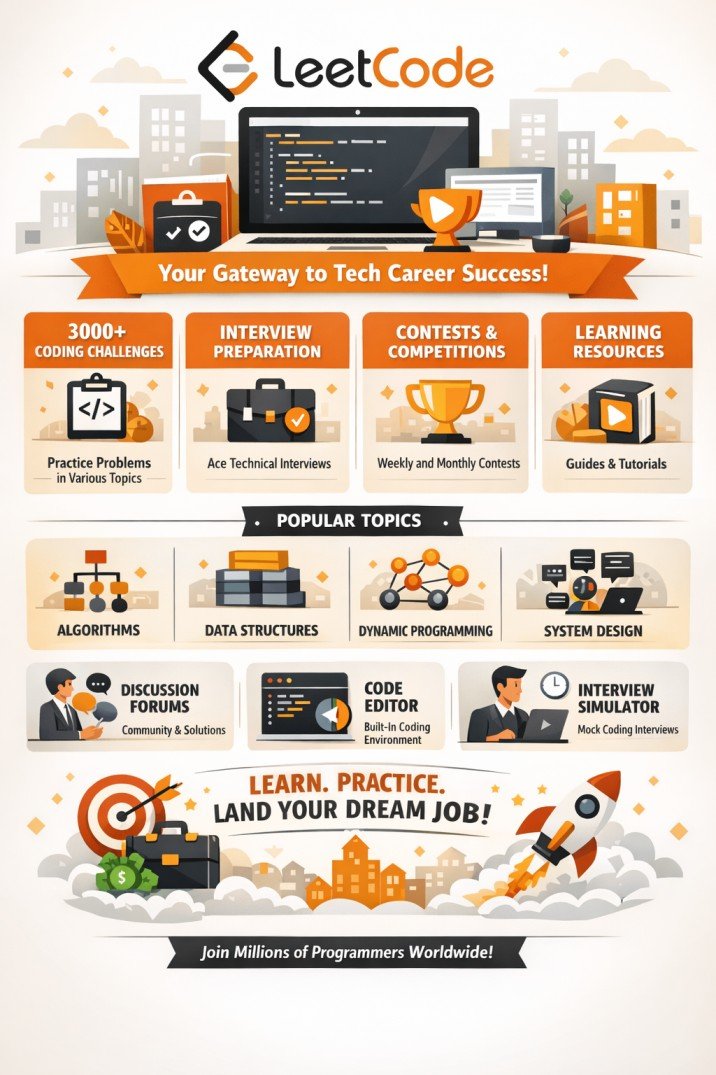
LeetCode is an online coding platform that challenges users with algorithmic programming tasks that are similar to technical interview questions. Its primary ecosystem includes over 2,350 problems categorized by difficulty (Easy, Medium, Hard) and technical domains such as Data Structures, Algorithms, SQL, and System Design.
To understand why your interview is about reversing a linked list, we need to look at the history of the software interview. Tech companies used to ask quirky brainteasers in the early 2010s. Candidates were asked things like: “How many piano tuners are there in Chicago?” or “How do you measure exactly 45 minutes using two separate strings that burn inconsistently for an hour?”
They were designed to test abstract critical thinking . In practice they were very subjective, arbitrary and easily gatekept by people who’d just heard the riddle before. With the emergence of tech classics like Cracking the Coding Interview and platforms such as LeetCode, the industry shifted towards standardized technical puzzles. At least these were based on computer science fundamentals, but they posed a new problem: the asymmetry of the hiring process.
The High Volume Elimination Filter
Just think about the predicament of Big Tech companies such as Google, Meta or Amazon. Thousands of applications can come in for one open software engineering position. Even when automated resume screening filters out the obviously unqualified, recruiters still have hundreds of qualified developers to sift through. It takes money to interview a candidate. It takes an experienced staff engineer away from building core products for an hour or more
The 45-minute technical screens used by Big Tech companies are a blunt instrument of elimination, not selection. They are happy to have high rates of false negatives (rejecting great engineers who had a bad day) because their applicant pipeline is functionally infinite.
The Trouble with Meritocracy
Critics correctly point out that this framework places the entire burden of training and evaluation on the applicant. You practice in your spare time for months . Then an algorithm grades you and sorts you .
There is an unexpected upside to this standardization though. Without an objective baseline for coding, hiring managers would rely heavily on subjective cues such as the prestige of your university degree, academic GPA, or the famous logos already on your resume. The LeetCode framework is an equalizer. If a developer from a non-traditional background or a self-taught boot camper can learn these patterns, it can open doors to major tech companies that would have been closed to them.
Make the Grind a Game
If you think of LeetCode as a chore that you have to do, you will burn out before you solve your fiftieth problem. The trick to staying alive on the platform is to change your relationship with the platform by exploiting its built-in gamification mechanics.
Track Metrics as Milestones, Not Failures: LeetCode grades your submissions based on runtime and memory usage, putting your code into a certain percentile versus other users. Don’t get obsessed with hitting the top 1% on every run. The system on LeetCode servers is variable, and the same code submissions can have very different runtimes on successive tests. Instead, use these metrics as general directional indicators to see whether your approach can be optimized from a slow nested loop to a clean linear scan.
Learn in Public to Break Routine: If you use Java or Python to solve common problems, you will end up with the same solutions as thousands of other people in the community forums. To make things more interesting, try solving problems in a second language you want to learn, or even in a niche paradigm like Racket or Haskell. Forcing yourself to implement standard data structures in a totally different language environment sharpens your understanding of language design and compilation.
Avoid the “Slot Machine” Trap: Many developers fall into a dangerous habit of making small tweaks to their code, hitting submit, checking the error, and tweaking again without truly understanding the problem. This trial-and-error cycle kills your engineering intuition. If your solution fails a hidden edge case, get up and walk away from the code editor. Before you code, write down the failing input by hand, trace your variables on paper and find the logical gap.
Technical Comparison: Reviewing Code Practice Ecosystems
For ease of preparation, it is useful to compare and contrast how the major platforms organize their problems, interfaces, and intended use cases.
LeetCode: Best for immediate interview prep for Big Tech. It has a large question bank, very active community forums and company-specific tracking arrays. However, it suffers from an unstructured progression path and hides high-frequency corporate questions behind a paywall.
HackerRank: Good for studying structured concepts and conducting employer assessments. Provides free code autocomplete, linear organized skill paths, and mimics real corporate testing interfaces. On the downside, it has less community discussion compared to LeetCode.
GeeksforGeeks: As a conceptual reference and in-depth resource. It features in-depth articles that explain algorithmic formulas one step at a time. The only real downside is the ad-filled layout that can mess up your reading and break your concentration.
Project Euler: problems that are pure mathematics. It provides very satisfying logical puzzles that help you build structural programming skills, but there is little cross-over with the typical corporate UI/UX developer interview.
The Hidden Practical Value for Real-World Developers
But if LeetCode questions are so different from day-to-day web and mobile development, then why bother with them if you aren’t job hunting? With the right mindset, the platform helps you develop professional skills that you can directly transfer to your day-to-day production code.
Syntactic fluency in second languages
Many of us have a primary language we use for work (e.g. TypeScript or Java) but want to keep our skills fresh in a secondary language (e.g. Python or Go). LeetCode provides a great low-friction environment to practice writing clean syntax, without all the overhead of setting up local development environments, build systems, or external dependencies. You can focus purely on manipulating core data collections and language features.
Unlocking Hidden High Performance Data Structures
In normal application development we are dealing with almost exclusively standard Arrays, Maps and Sets. LeetCode makes you explore more specialized structures that you may have skipped in school or boot camp.
Consider the Disjoint Set (Union-Find) structure. Not often mentioned in basic tutorials, it is an elegant, high-performance option for finding connected components in a network. When you grind through classic “island isolation” matrix problems on LeetCode, you get to know how these data structures work under the hood. Next time you face a complex state-management challenge or a complex network-routing problem at work, you’ll have a much larger technical toolkit to draw from.
Understanding The Limits of Algorithms
As you work through these problems, you’ll find yourself needing to internalize things like Dynamic Programming, sliding windows, and two-pointer traversals. You might never code a mergesort by hand in a typical business application, but knowing why a particular approach scales well lets you avoid accidentally introducing performance bottlenecks into your production applications.
Going Beyond the Browser: Academic Deep Dives
Eventually you will reach a point where short forum explanations and short youtube tutorials are not helpful anymore. A lot of the explanations on code websites are written by recent grads or anonymous users who will show you how to fix your code, but won’t teach you the mathematical foundations behind it. When you get to that point, the best way to scale your skills is to move away from short-form content and open classic academic textbooks.
Taking time with Donald Knuth’s seminal series, The Art of Computer Programming or the prerequisite text Concrete Mathematics can change your perspective of your work. These books are written with amazing wit, accuracy and depth and they give a humbling view of computer science that exceeds the superficial realm of a job interview. They teach you how to systematically analyze code, and give you a level of technical depth that short-form study guides simply can’t match.
The AI Factor: Will LLMs replace LeetCode?
Today, we cannot talk about coding practice without the presence of Large Language Models (LLMs). Many LeetCode problems can be solved instantly with the help of tools such as ChatGPT, Claude or coding-specific models. Is learning these algorithms a waste of time?
To see how AI interacts with these problems, look at some recent experiments that looked at LLM performance on coding challenges. The data shows a very clear, consistent pattern: modern AI models achieve near-perfect success rates on standard, well-known historical LeetCode problems because those variations are well-represented in their training data.
But when they are faced with real “unseen” problems – puzzles with new constraints or requiring different logic paths and not solvable by simple pattern recognition – their success rates drop dramatically.
That’s precisely why human algorithmic skills are still so important. LLMs are very good at stringing together rote, repetitive patterns that humans tend to skim over. But if you rely on an AI to produce your solutions during your preparation, you are missing out on the very cognitive friction that builds your engineering intuition. The value of LeetCode is not the final code snippet you produce; it is the mental model you build while figuring out the solution yourself.
8 Tips to Safely Master LeetCode
If you’re ready to develop a sustainable and effective practice routine, use these principles to guide your study sessions:
Timebox Every Single Session: Never let one problem linger for hours. Set aside 30 to 45 minutes of uninterrupted time to focus. If you haven’t made any meaningful progress by then, stop and look at the solution article.
Read Explanations Carefully: Don’t copy the top-voted solution. Refer to the text that comes with the code to see why the optimal method is the best one and how the author dealt with the edge cases.
Practice Verbalizing Your Logic: Code quietly, but talk through your thinking. Interviewers care as much about your communication skills and your ability to overcome obstacles as they do about your final code syntax.
Focus heavily on patterns. Don’t try to memorize hundreds of individual problems. Rather, learn to recognize the 14 core underlying patterns, such as Sliding Windows, Two Pointers, and Breadth-First Search.
Start with Core Problem Sets: Don’t pick questions randomly. Use curated, high quality community lists like LeetCode 75 or Top Interview 150 to build a well-rounded, comprehensive foundation.
Simulate Real Interview Pressure: Once a week, turn off your IDE’s autocomplete, set a strict 45-minute timer, and solve a new problem on a digital whiteboard without running test cases until you are done.
Review Your Old Code Regularly: Go back to a problem you solved a month ago. Many times you will find that you tackle it differently, enabling you to improve your original solution with what you have learned since.
Maintain an Active Balance with Practical Work: Remember that LeetCode is a supplement, not a replacement for real development. Mix algorithmic study with building actual real world applications where you manage real dependencies, deployment pipelines and user feedback.
Frequently Asked Questions
How many LeetCode problems should I solve before I start interviewing?
There is no magic number, but most developers would agree that solving 75 to 150 well-chosen problems (focused heavily on Medium difficulty) gives enough pattern recognition to feel confident during a typical Big Tech technical assessment.
Are LeetCode Premium subscriptions worth the money?
If you are targeting a specific company like Google or Apple who are known to use certain high frequency questions, then a short subscription may be worth it to look at their recent question pools. The free tier has more than enough content to cover general skill building and standard interview prep.
What level of problem should I practice? Easy, Medium, or Hard?
Dedicate 70% of time to Medium problems as they are the backbone of most technical interviews. Easy problems are good for learning the syntax of a new language or for warming up. Hard problems are for advanced practice after you have mastered the foundational patterns.
What should I do if I am totally stuck on a problem?
If you spent 30 minutes tracing your code and can’t get anywhere, look at the solution. But being stuck for hours doesn’t breed insight, it breeds frustration. Review the optimal solution, make notes on the underlying idea, and try to re-implement the solution from memory after a few days.
What is the best language to use for LeetCode?
Please write in whichever language you are most comfortable writing under pressure. The reason why Python is so popular is that its clean and readable syntax lets you express complex algorithmic ideas with minimal boiler plate code, saving you precious time in an interview.
Do smaller startups use LeetCode in their hiring process?
Depends. While many smaller startups have moved away from algorithmic riddles in favor of practical take-home projects or code-review assessments, many still use short LeetCode screens to quickly evaluate basic programming competency.
How do I keep from losing solutions I’ve already solved?
Avoid memorizing the code itself. Instead, concentrate on the structural patterns. Keep a simple study journal where you write a two-sentence summary of the core trick for each problem, like using a minimum heap to efficiently track elements.
Is there a way to crush technical interviews without touching LeetCode?
Yes. There are a lot of companies that specifically avoid algorithmic puzzles and focus instead on practical pair programming, system design, or architecture reviews. There are curated directories on the internet of companies that don’t have LeetCode screens.
How long should I study before applying for roles?
If you can do it for an hour each day, then a window of 2 to 3 months is usually the sweet spot. This gives you enough runway to learn the core data structures in-depth without burning out before your interviews start.
So, does doing well on LeetCode make you a good software engineer?
Not across the company. LeetCode tests a specific set of skills: how to optimize performance, how to structure an algorithm and how to write code fluently under pressure. A good production engineer also needs to be good at things like system architecture, writing maintainable code, working across teams, and understanding customer needs. None of that can ever be measured by a browser console.

Leave a Reply